Matura thesis: From muscle power to electricity
My Matura thesis. I fitted a rowing ergometer with a generator to turn training effort into electricity, tested it five times and calculated whether it could power my rowing club.
#mechatronics #analysis3 min readLast updated
- Role
- Concept, build, testing and report
- Timeframe
- –
- Team
- Individual
- Status
- Completed
- Tools
- Soldering, 3D-printed parts, Woodworking, Power meter
- Links
Read the paper
In German · 38 pages · PDF 2.8 MB
- total cost of the parts
- 399CHF
- best continuous output (generator rated at 300 W)
- ≈5W
- test runs, July to September 2023
- 5
- of the rowing club's yearly electricity, in theory
- ≈1/20
Overview
Question
The thesis, written in German at Gymnasium Biel-Seeland (Matura 2024), asks two questions:
- How can a rowing ergometer be modified so that the energy put into training is turned into electricity?
- Could the ergometer training at Seeclub Biel, the rowing club where I train, cover the club’s electricity use?
Approach
A Concept2 ergometer (model D/E) drives a three-phase permanent-magnet generator from a small wind turbine (rated 300 W at 600 rpm). The generator is coupled to the ergometer’s flywheel with a 3D-printed connector. A three-phase rectifier turns its AC output into 24 V DC, which passes through a power meter (V, A, W) into an inverter from 24 V DC to 230 V / 50 Hz AC. All parts sit in a self-built wooden box whose height puts the generator in line with the flywheel axle. The parts cost CHF 399, just under the CHF 400 budget.
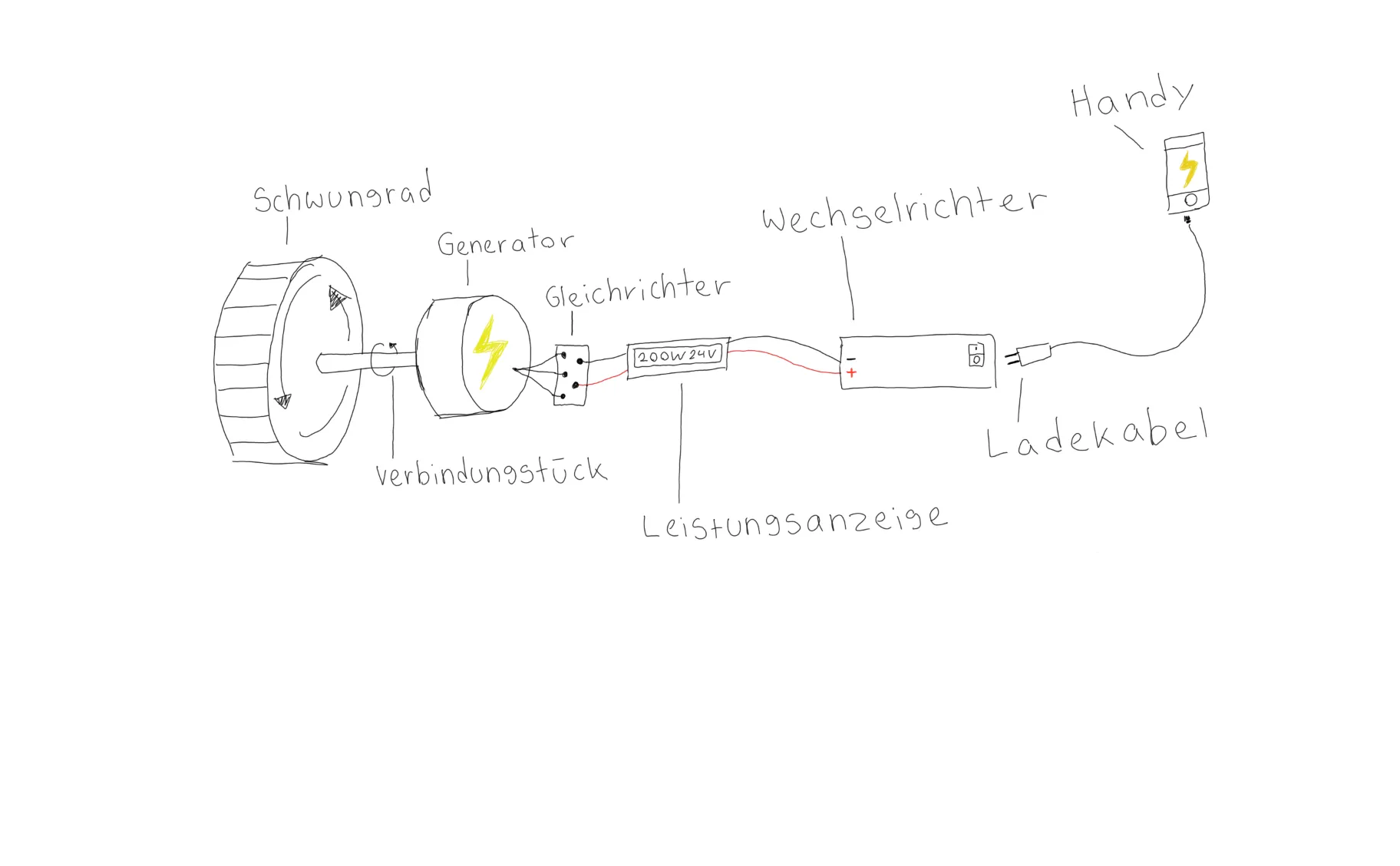
The installation as drawn in the thesis (Fig. 1).
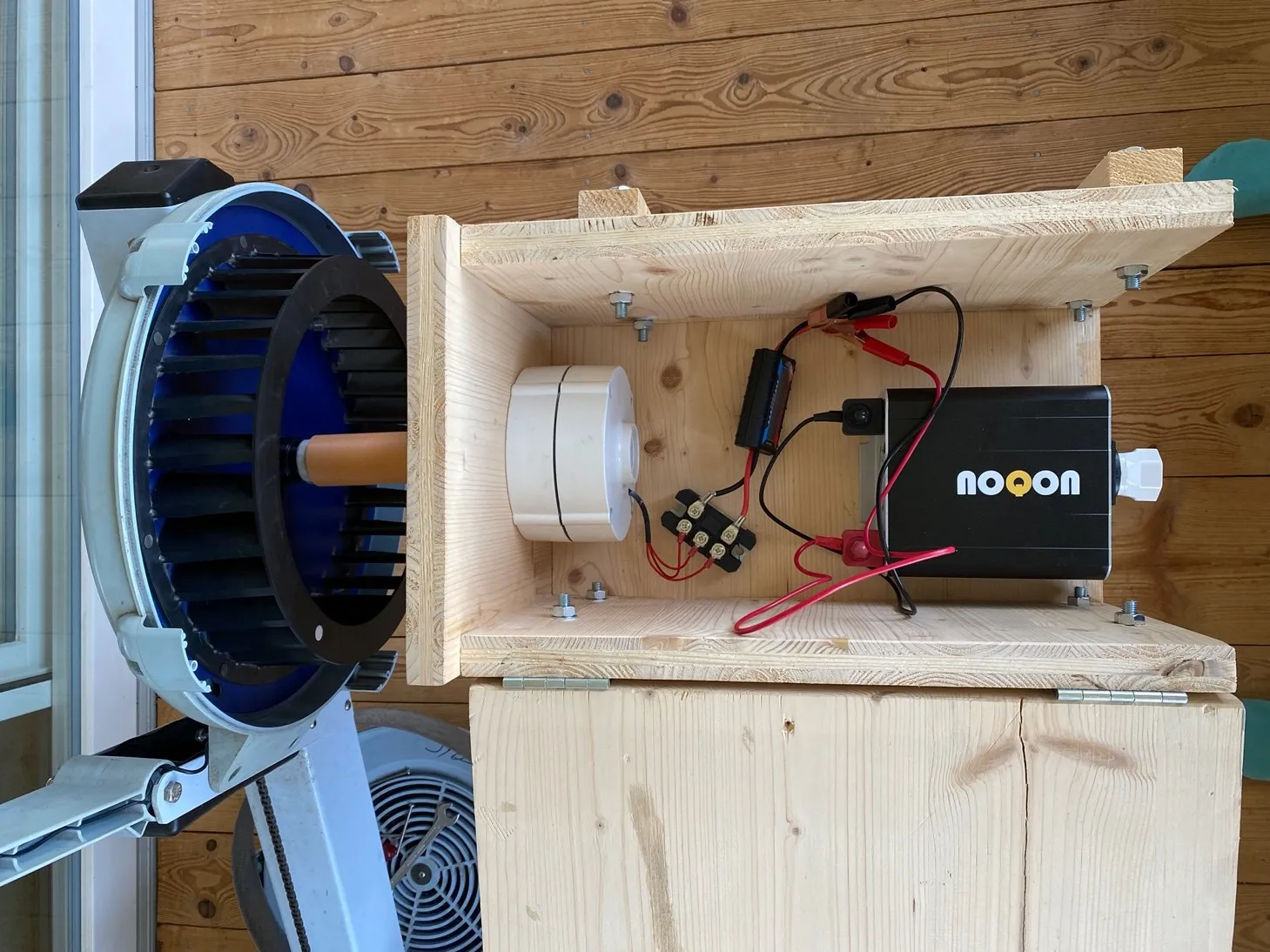
The finished installation, with the box open (Fig. 2).
Five test runs between July and September 2023 each tackled the problem found in the one before:
- Test 1: With a phone charger as the load, the inverter kept switching off and beeping for too low or too high voltage. The voltage rose and fell with the rowing intensity. The power meter mostly showed 0 W, sometimes about 5 W.
- Test 2: With a kettle as a larger load, the inverter ran and the voltage was steady, but the output stayed at about 5 W.
- Test 3: A second connector with a notch and a wooden counterpart was meant to stop the coupling from slipping. The counterpart did not hold, so the connector was strapped to the flywheel with cable ties, which worked. The solder joints stayed cold after five minutes of rowing, which ruled them out as a source of loss.
- Test 4: The voltage held at about 14 V, but the power stayed at 0 W, with peaks of 3 W at most.
- Test 5: After the last clamped connection was replaced by solder joints, the inverter beeped again and the output peaked at 10 W.
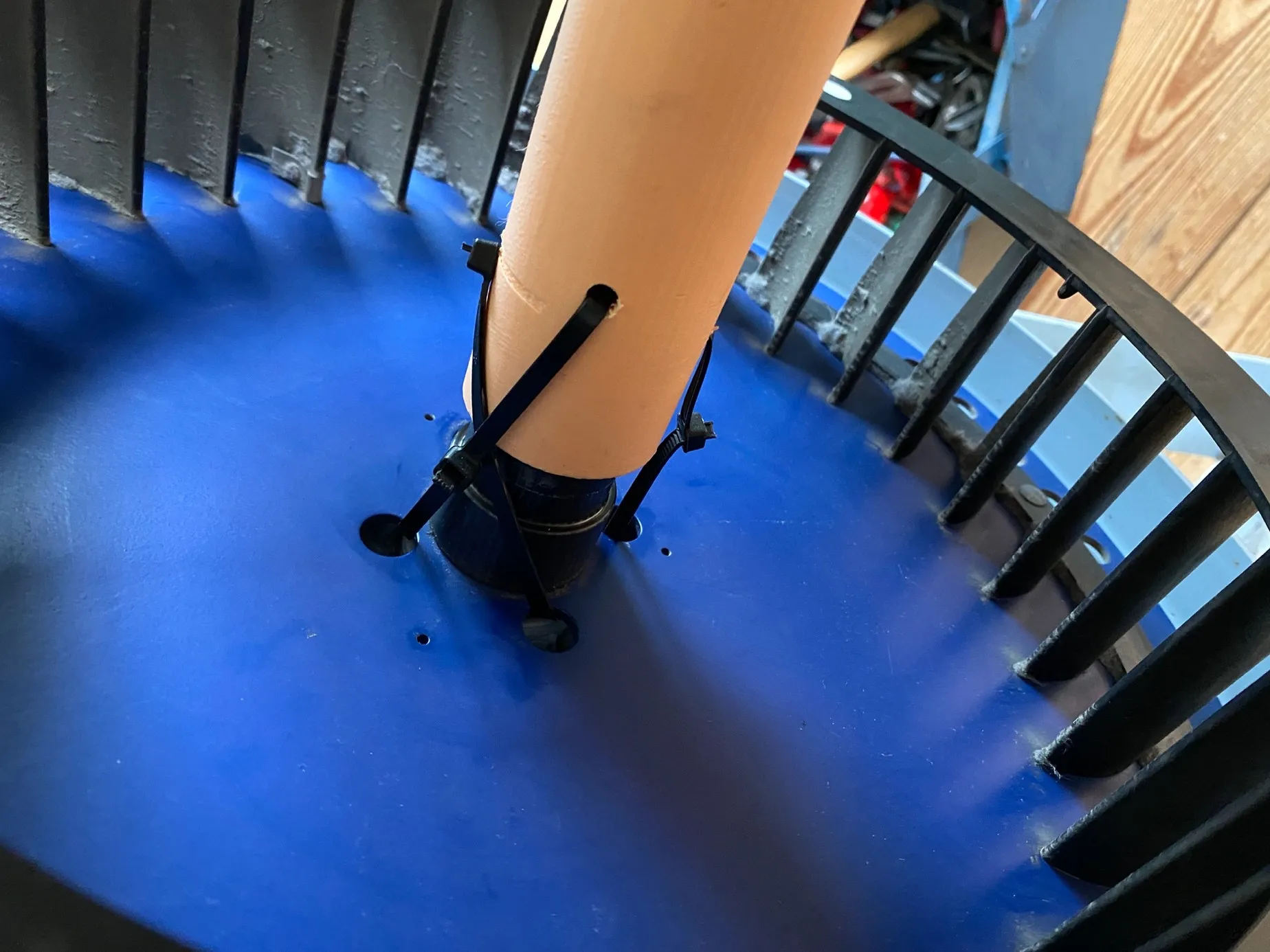
The connector fixed to the flywheel with cable ties (Fig. 17).
Results
At its best the installation delivered about 5 W continuously, far below the generator’s 300 W rating, and only supplied the connected device with small amounts of power from time to time. Charging a phone did not work.
For the second question, the thesis assumes a fully working installation with 100 % efficiency. Based on how often the club’s racing and recreational rowers train on the ergometers, it estimates 413.4 kWh per year, about 1/20 of the club’s 8,461 kWh consumption in 2022. Covering all of it would take all eight ergometers being rowed 14.5 hours a day, every day of the year. At about 32 Rp./kWh that saves CHF 132 a year, while eight installations would cost CHF 3,192, a payback time of about 24 years. One ergometer’s output would, however, roughly be enough to run a fridge, a PC or a TV.
Conclusion
The installation was built as planned, but it did not deliver the expected power, and the investment would not pay off for the club. The thesis names several likely reasons: components that may not have been the right choice, a budget of CHF 400 and missing expert knowledge to track down the problems. Next time it would plan more time for choosing the components, get an electrician’s or another expert’s opinion early on, and set a clearer goal (charging a phone, feeding the grid or running a device in real time).